
Foundations of Business Operations & Analytics
1 Introduction to Business Operations and Analytics

Learning Objectives
-
Define business operations and explain its role in transforming strategy into actionable results.
-
Differentiate between manufacturing and service operations, recognizing the unique challenges of each context.
-
Identify the scope of operations within an organization, including process flows, quality control, technology, and compliance.
-
Explain how operations contribute to efficiency, quality, customer satisfaction, and strategic alignment.
-
Distinguish between business analytics and business operations analytics, and describe how each supports organizational decision-making.
-
Apply abstract operations concepts to a real-world scenario using example case studies, such as Pemi Coffee Roasters, to analyze workflow, scheduling, and resource management.
1.1 What Is Business Operations
Business operations is the everyday reality of how an organization gets work done. It’s not a slogan or a vision statement—it’s the people, the tools, the schedules, the problem-solving that actually make things happen. You can write the smartest strategy in the world, but without operations, it stays stuck on paper.
It looks different in different settings. A clothing manufacturer might be chasing down a delayed shipment of fabric while figuring out how to keep the sewing line busy. A healthcare clinic might be adjusting patient appointments on the fly when two nurses call out. The details change, but the purpose doesn’t: get the right things to the right people at the right time, without breaking the budget.
Example: Operational Juggling at Pemi Coffee Roasters
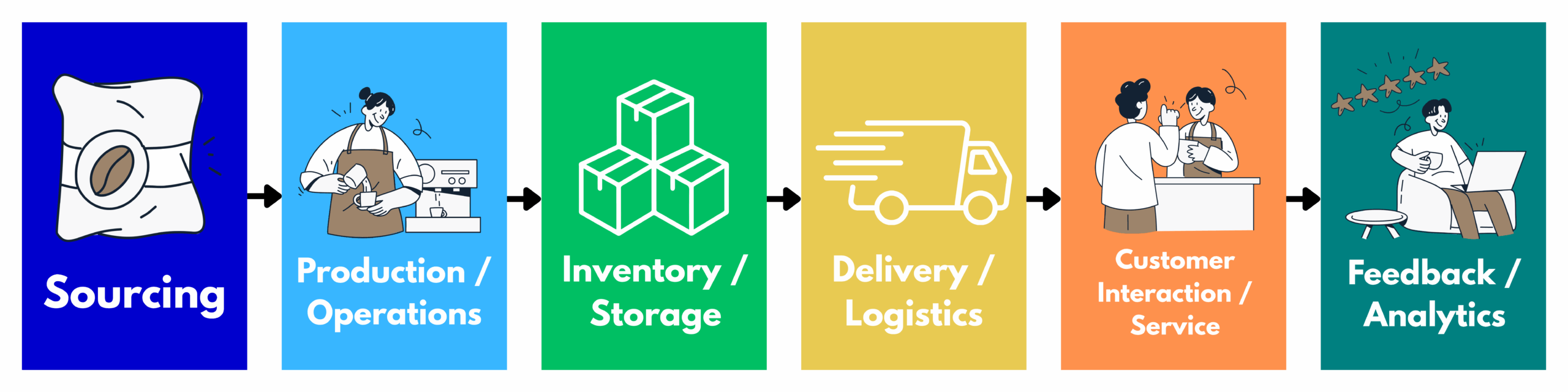
Pemi Coffee Roasters balances daily café service with wholesale orders and online shipments. A late green-bean delivery affects roasting schedules, which in turn can delay café supply and online orders. Staff must adjust roasting, packaging, and delivery plans quickly to keep everything on track, showing how operations decisions ripple across the organization.
The work isn’t just about doing tasks. It’s about deciding how those tasks should be done in the first place. Who’s the best person for this step? Which system will keep the process moving? Where are we wasting time or resources without realizing it? People who manage operations tend to have a knack for seeing the whole picture—like a chess player who’s already thinking three moves ahead—but they also know when to improvise.
And the ground is always shifting. Supply chains tangle. Software updates roll out whether you’re ready or not. Customer expectations creep higher each year. A manufacturer might bring in automation to keep pace; a service provider might adjust its offerings to focus on what it does best. Surprises happen, and operations is often where the scramble to adapt plays out.
Over time, patterns emerge. The smart operators pay attention to those patterns and look for ways to make things smoother. Sometimes the fix is small—rearranging a workspace so people stop tripping over each other. Sometimes it’s a bigger change, like overhauling the way orders are processed. Bit by bit, those adjustments determine whether the organization runs smoothly… or just runs in circles.
Example: Workflow Adjustments in Action
At Pemi, staff noticed bottlenecks during the morning rush when both café and wholesale roasting tasks coincided. By shifting packaging to the afternoon and reallocating baristas temporarily, the company smoothed workflow and reduced wait times, showing how observing patterns leads to practical operational solutions.
Whether you end up in a warehouse, behind a desk, or managing a team in a busy hotel, knowing how operations work changes how you see things. You start to notice the chain of events that takes an idea, a box of materials, or a set of instructions and turns it into something useful. You also notice how small decisions—some you might barely remember making—can shift costs, slow things down, or make customers happier. In this course, we’ll get into the methods and tools that keep operations on track, but we’ll also talk about the messier side: the judgment calls, trade-offs, and quick thinking that show up when the real world doesn’t go by the book.
1.2 The Scope of Business Operations
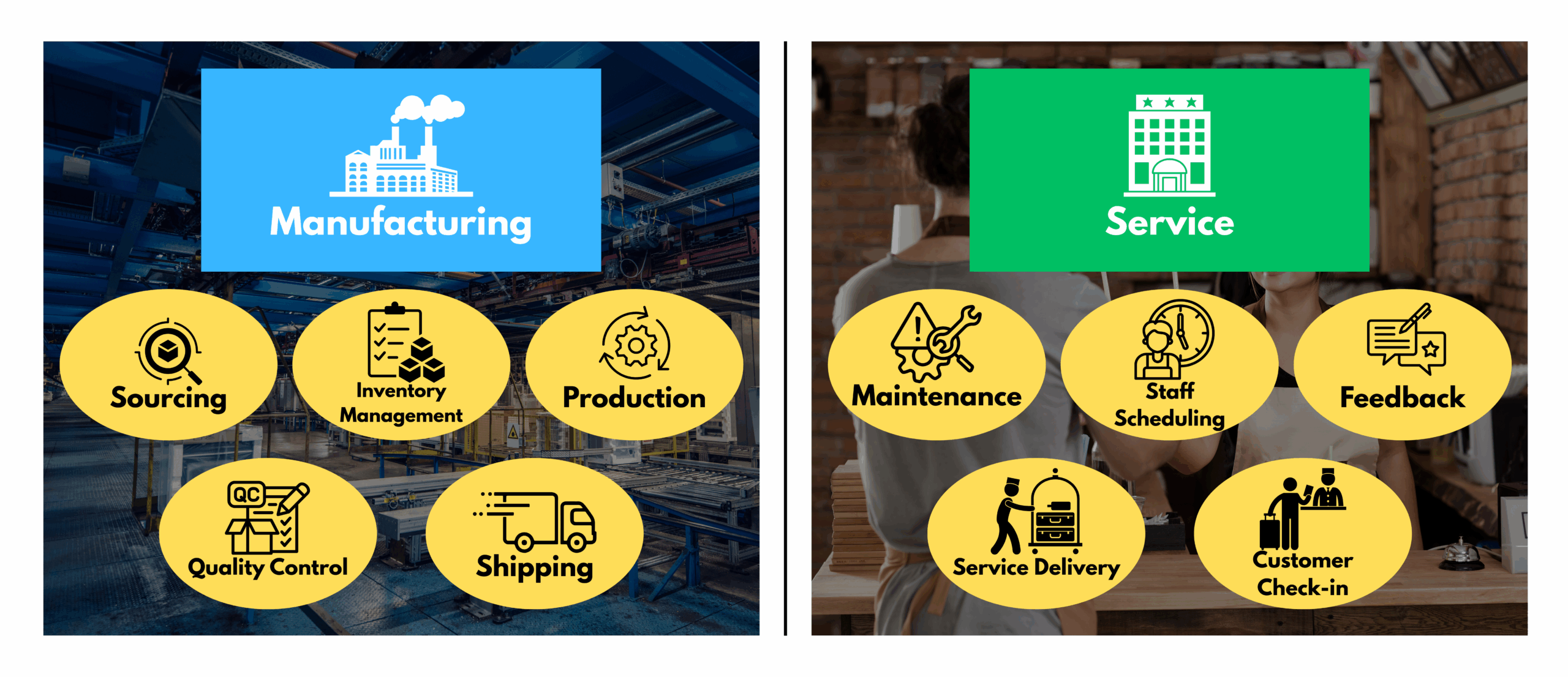
Business operations is a wide-reaching field that connects more parts of an organization than most people think about. It’s not a single room full of people doing the same task—it’s the thread that runs through almost everything a company touches. Making something or delivering a service is only the surface layer; beneath that is a network of decisions, handoffs, and fixes that keep it all from stalling.
In manufacturing, you can see the physical flow. A bicycle maker might place orders for components months in advance, track them across oceans, assemble them on the factory floor, and send finished bikes to stores before the season changes. If a shipment of pedals shows up late or a step in assembly gets held up, the whole rhythm shifts. Operations isn’t just “make the bike.” It’s making sure every part of that chain stays in sync.
Services can be harder to picture, but the same rules apply. A hotel on a busy weekend is a good example—housekeeping turning over rooms, maintenance trying to stay ahead of small repairs, the front desk managing early arrivals while the lobby fills. One delay in cleaning can back up check-ins, which means the front desk staff starts the day explaining instead of welcoming. That’s operations too.
Example: Service Flow at Pemi
Pemi cafés must manage a mix of regular customers and tourist traffic. During peak leaf-peeping season, baristas and front-of-house staff adjust schedules, streamline drink prep, and monitor inventory in real-time. These small operational decisions ensure smooth service, illustrating that operations principles apply equally in service contexts.
It’s not all front-line work either. Quality checks, safety protocols, compliance paperwork, environmental commitments—they live inside operations as well. When a company decides to cut waste, switch to a greener supplier, or change packaging, those choices land here first. They can improve efficiency, but they also change how the business is seen by customers and partners.
Technology changes the game further. Small companies and large enterprises alike use software to track inventory, plan production runs, manage shipments, and predict maintenance needs. The tools are different, but the goal is the same: keep the work moving and the surprises to a minimum.
And nothing stays still for long. A change in the market, a shift in customer preferences, or something unexpected—weather, a supplier going under, even a news event—can throw things off quickly. The organizations that handle it best treat operations as something alive. They check in on it, tweak it, and sometimes overhaul it before they have to. That habit isn’t just about surviving problems—it’s often how they get ahead.
1.3 The Role of Operations in Organizational Success
Operations is more than a support function; it is a central driver of organizational success. An organization can have a brilliant marketing strategy and an innovative product, but without strong operations, it will struggle to deliver on promises and maintain customer trust.
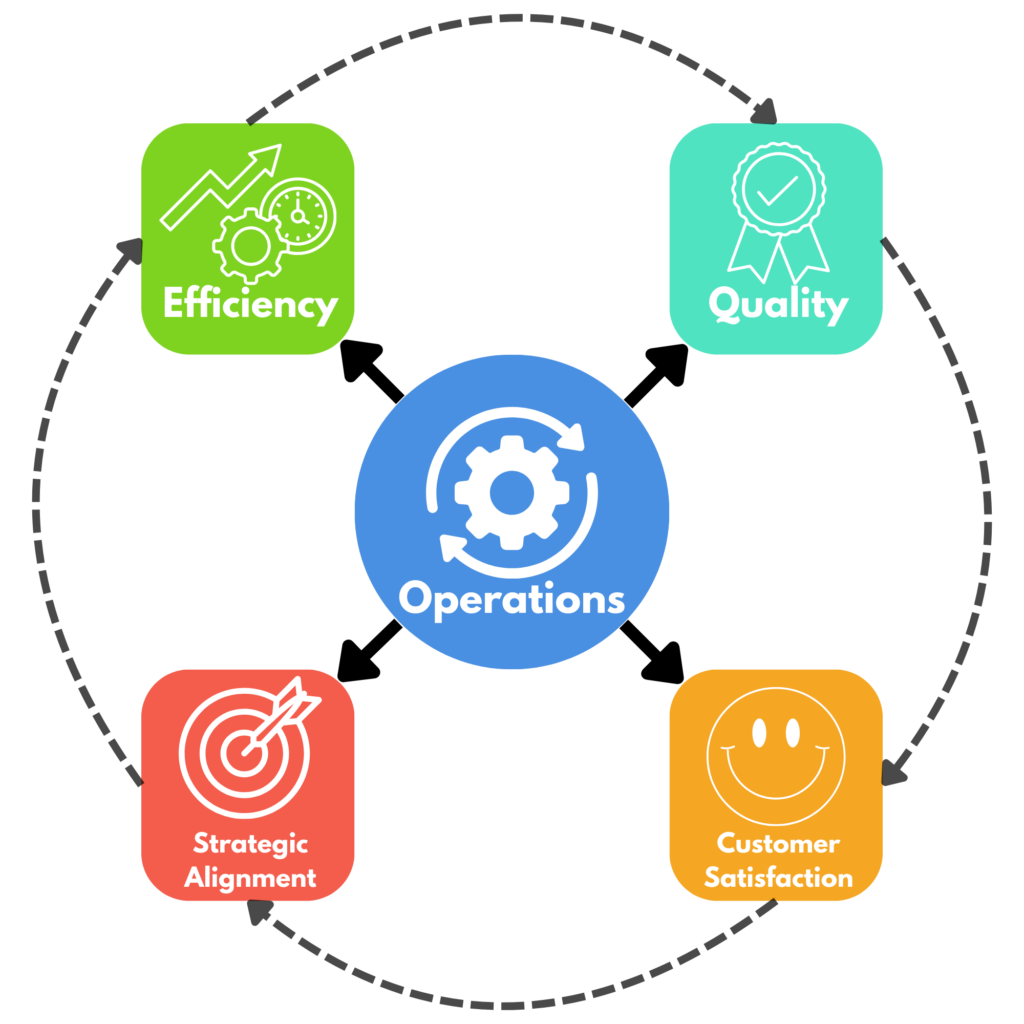
One of the most significant contributions operations makes is to efficiency. Streamlined processes reduce waste, save time, and minimize costs. This efficiency can translate into competitive pricing, higher profit margins, or reinvestment into areas like research and development.
Example: Efficiency Gains at Pemi
By coordinating roasting schedules with café demand and online orders, Pemi ensures beans are roasted just-in-time. This reduces storage costs, keeps coffee fresh, and minimizes labor spent managing inventory. Small operational efficiencies like this can have a large impact on overall performance.
Operations also play a critical role in quality. Consistency is a hallmark of successful organizations. Customers expect the same level of quality each time they interact with a company, whether they are ordering a product online, visiting a store, or booking a service. In manufacturing, quality assurance processes verify that products meet specifications before they leave the factory. In services, training programs and standard procedures help ensure that customers receive the same level of care and attention at every location or touchpoint.
Customer satisfaction is another area where operations has a direct impact. Reliable delivery times, responsive service, and a seamless experience contribute to customer loyalty. When operations falter, customers notice. A late delivery, a defective product, or a poorly executed service can quickly erode trust and damage the brand’s reputation.
Strategic alignment is an often-overlooked aspect of operations. The best-run operations are those that support and reinforce the organization’s overall strategy. If a company differentiates itself based on rapid delivery, its operations must be designed for speed, from supplier relationships to warehouse layout to last-mile logistics. If the company emphasizes sustainability, operations must focus on sourcing environmentally responsible materials, reducing energy use, and minimizing waste.
In addition, operations are a source of valuable data. By tracking production times, defect rates, inventory levels, and customer feedback, organizations can identify trends and make informed decisions. This is where business operations analytics becomes essential, turning raw data into actionable insights that guide process improvements and strategic planning.
Ultimately, operations is not just about keeping the business running; it is about enabling the business to thrive. When operations are aligned with strategy, managed efficiently, and continuously improved, they become a powerful engine for growth and competitive advantage.
Business operations and business operations analytics are not just academic fields. They represent large and growing areas of employment. According to the U.S. Bureau of Labor Statistics, management and operations related roles remain among the strongest employment sectors, with steady demand projected (U.S. Bureau of Labor Statistics, 2024). This outlook reinforces why learning the fundamentals of operations and operations analytics is valuable for managers preparing to enter the workforce.
1.4 The Difference Between Business Analytics and Business Operations Analytics
The terms business analytics and business operations analytics are closely related but not interchangeable. Understanding the distinction between them is important because it shapes how we approach problem-solving in an organization and what kinds of decisions we aim to improve.
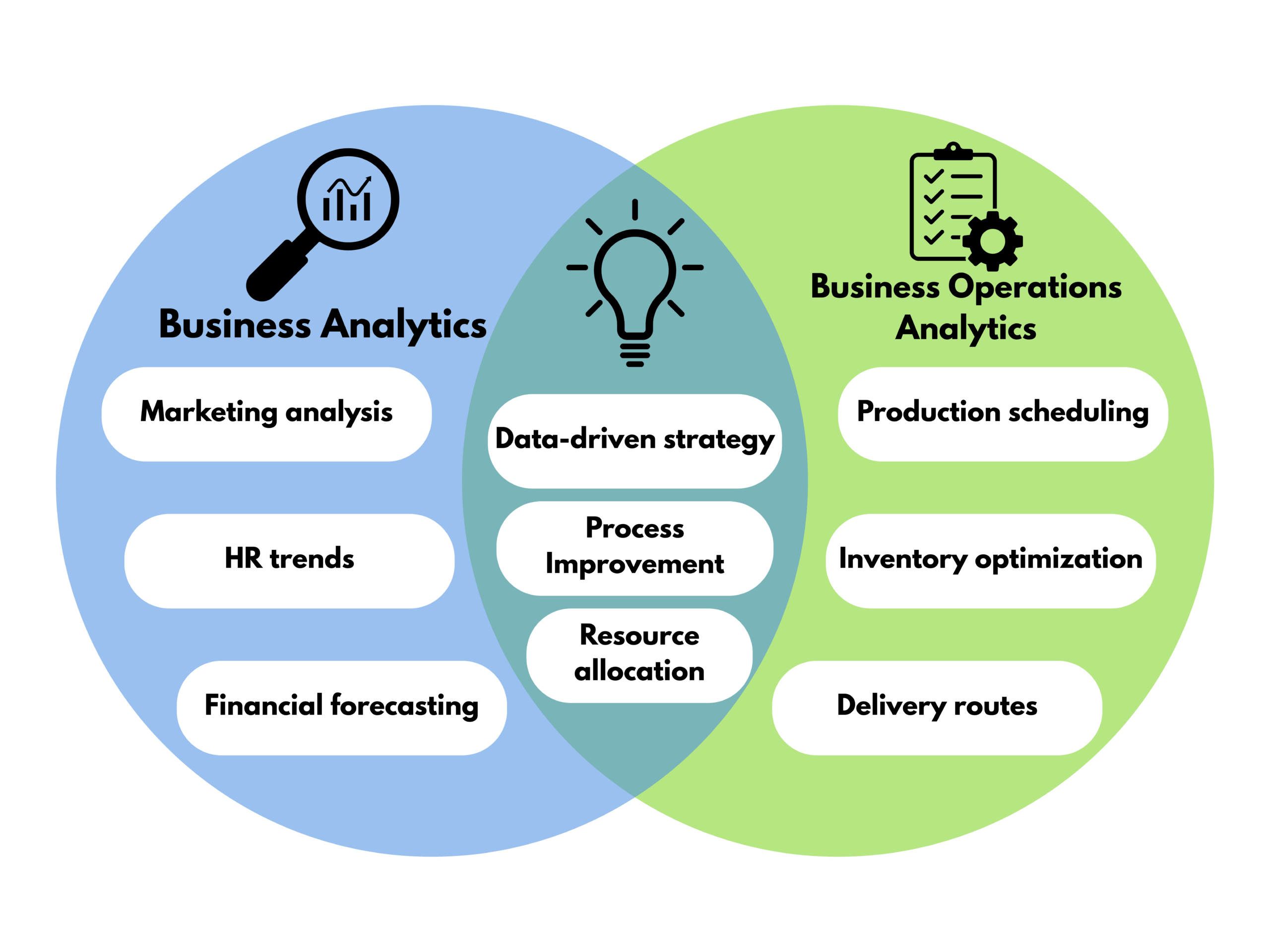
Business analytics is the broader discipline. It encompasses the collection, analysis, and interpretation of data to support decision-making across all areas of an organization. This might include marketing analytics to understand customer behavior, financial analytics to assess investment performance, or human resources analytics to evaluate employee retention trends. The focus is on using data to guide strategy and improve outcomes in any business function.
Business operations analytics is a specialized subset of business analytics. It applies the principles of analytics specifically to the processes and systems that produce and deliver an organization’s products or services. The emphasis is on operational efficiency, process improvement, and the performance of the value chain. Instead of asking, “How can we improve our overall business performance?” operations analytics might ask, “How can we reduce production cycle time by 10 percent without sacrificing quality?” or “Which delivery routes minimize both time and cost?”
Example: Operations Analytics at Pemi
Pemi uses sales and inventory data to adjust roasting schedules and optimize delivery routes. By analyzing historical demand patterns, the company reduces stockouts, avoids overproduction, and cuts shipping costs. This demonstrates how operations analytics translates data into concrete, actionable improvements.
The distinction can be illustrated by looking at the same organization from two perspectives. Consider a large hotel chain. A business analytics team might analyze guest demographics and booking trends to determine where to open new locations. Meanwhile, the operations analytics team would focus on optimizing housekeeping schedules, improving check-in processes, or managing inventory levels for linens and supplies to keep operations running smoothly.
The relationship between the two is complementary. Business analytics provides a wide-angle view of the organization’s performance and strategic opportunities, while business operations analytics zooms in on the day-to-day functions that make strategy possible. Strong organizations recognize the value of both perspectives and ensure they are integrated.
In this course, we will explore business operations analytics in depth, using analytical methods and tools to address challenges in production, service delivery, supply chain management, and process optimization. We will also draw connections to broader business analytics concepts so you can see how operational insights fit into the bigger strategic picture.
Key Takeaways
- Operations turn strategy into action.
- Operations are interconnected and dynamic across manufacturing and services.
- Efficiency, quality, and customer satisfaction are core outcomes of strong operations.
- Data and analytics make operations decisions faster and better.
- Theory + practice: case examples (e.g., Pemi Coffee) translate concepts into action.
- Continuous improvement keeps operations aligned with goals as conditions change
Chapter One References
Davenport, T. H., & Harris, J. G. (2017). Competing on analytics: The new science of winning. Harvard Business Review Press.
Heizer, J., Render, B., & Munson, C. (2020). Operations management: Sustainability and supply chain management (13th ed.). Pearson.
OpenStax. (2023). Introduction to business. OpenStax, Rice University. https://openstax.org/details/books/introduction-business
Slack, N., Brandon-Jones, A., & Burgess, N. (2022). Operations management (10th ed.). Pearson.
U.S. Bureau of Labor Statistics. (2024). Business employment dynamics. https://www.bls.gov/bdm/
The processes, people, tools, and decisions that turn strategy into actionable results.
The ratio of useful output to input, often focused on minimizing waste and maximizing productivity.
Procedures and standards to ensure products or services meet defined specifications.
The measure of how products or services meet or exceed customer expectations.
Ensuring operational activities support and reinforce the organization’s overall strategy.
Ongoing efforts to enhance processes, products, or services incrementally over time.
The collection, analysis, and interpretation of data to inform decisions across an organization.
The application of analytics specifically to operational processes, focusing on efficiency, performance, and process improvement.
The set of interconnected activities that add value as a product or service moves from raw materials to final delivery.